Journée francilienne d'accueil des postdoctorant.e.s en mathématiques
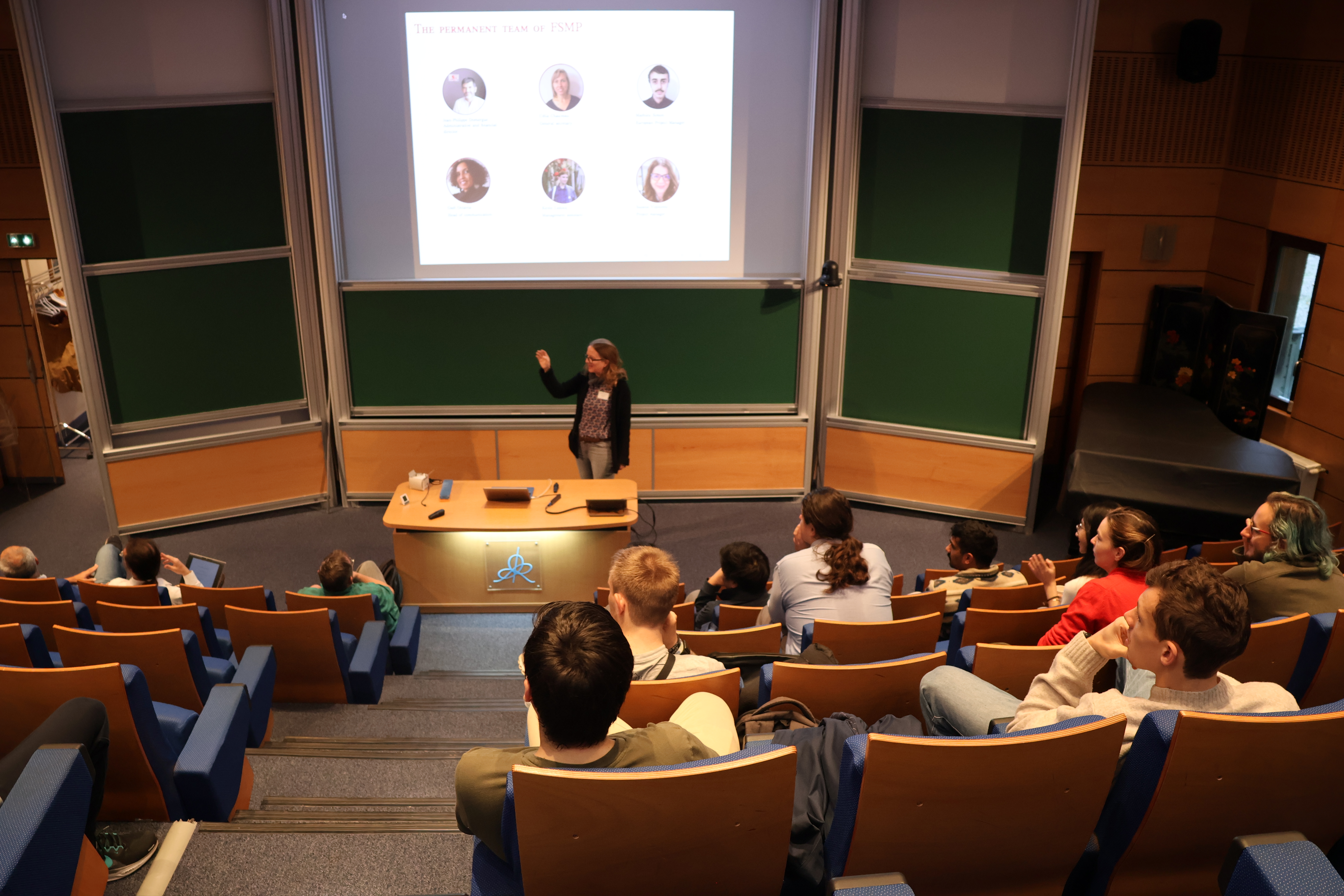
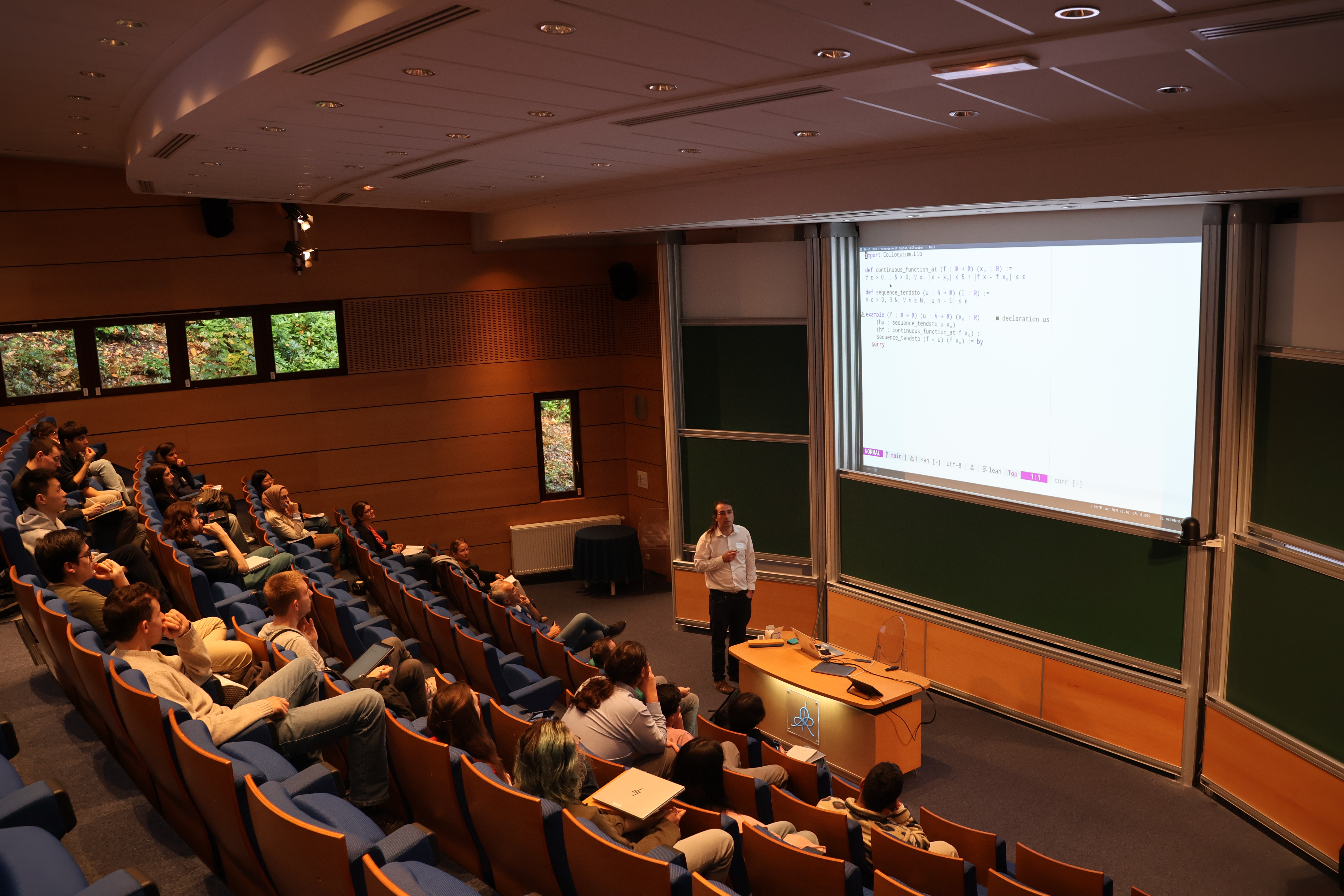
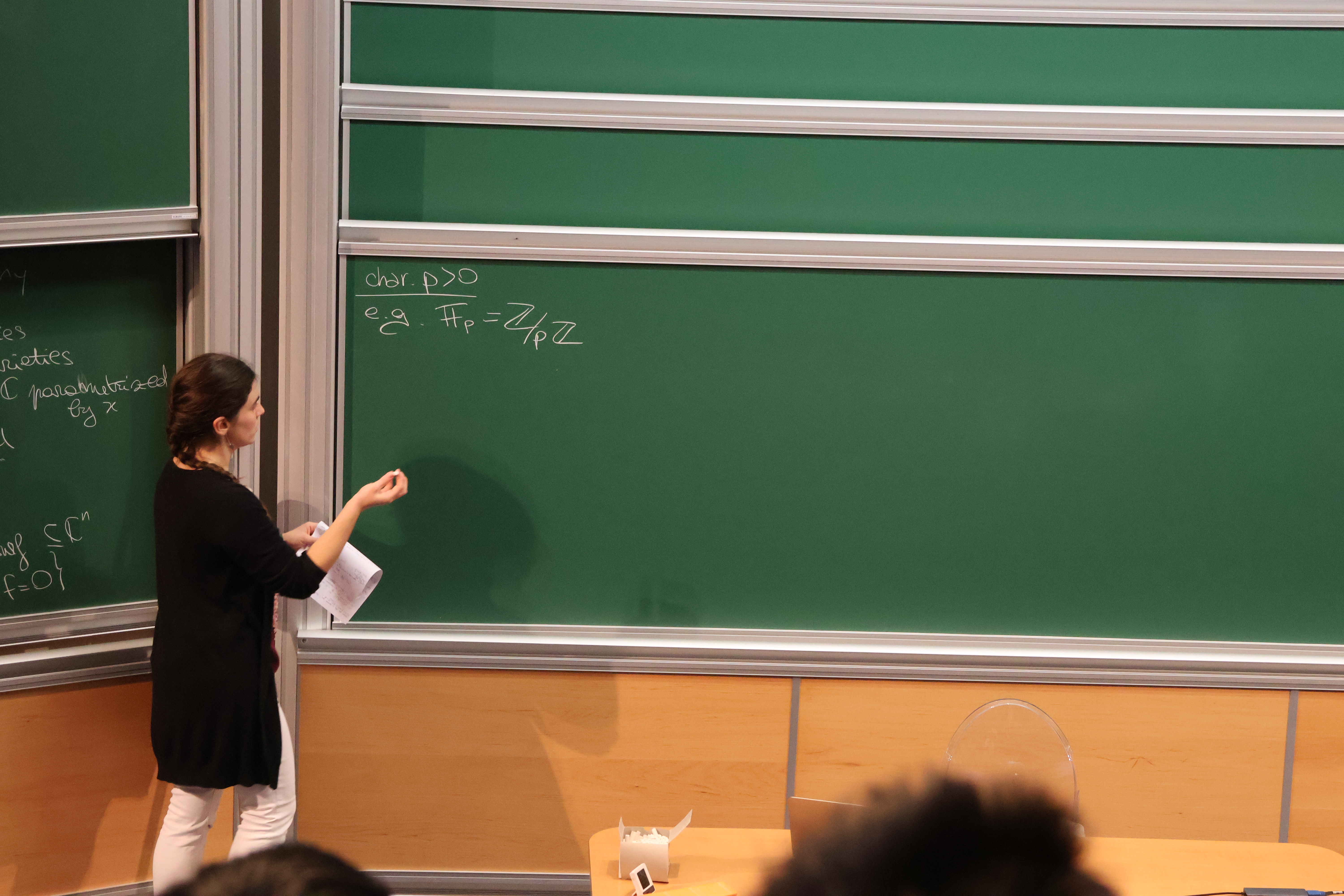
La journée est co-organisée par la FMJH, la FSMP et l’IHES. Comme son nom l’indique, cette journée s’adresse à tous les postdoctorant.e.s en mathématiques d’Île-de-France. Elle a pour but de permettre aux postdoctorants franciliens de faire connaissance, d’en apprendre d’avantage sur l’écosystème mathématique francilien ou encore de faire le point sur les opportunités de financement pour leurs éventuels projets de recherche.
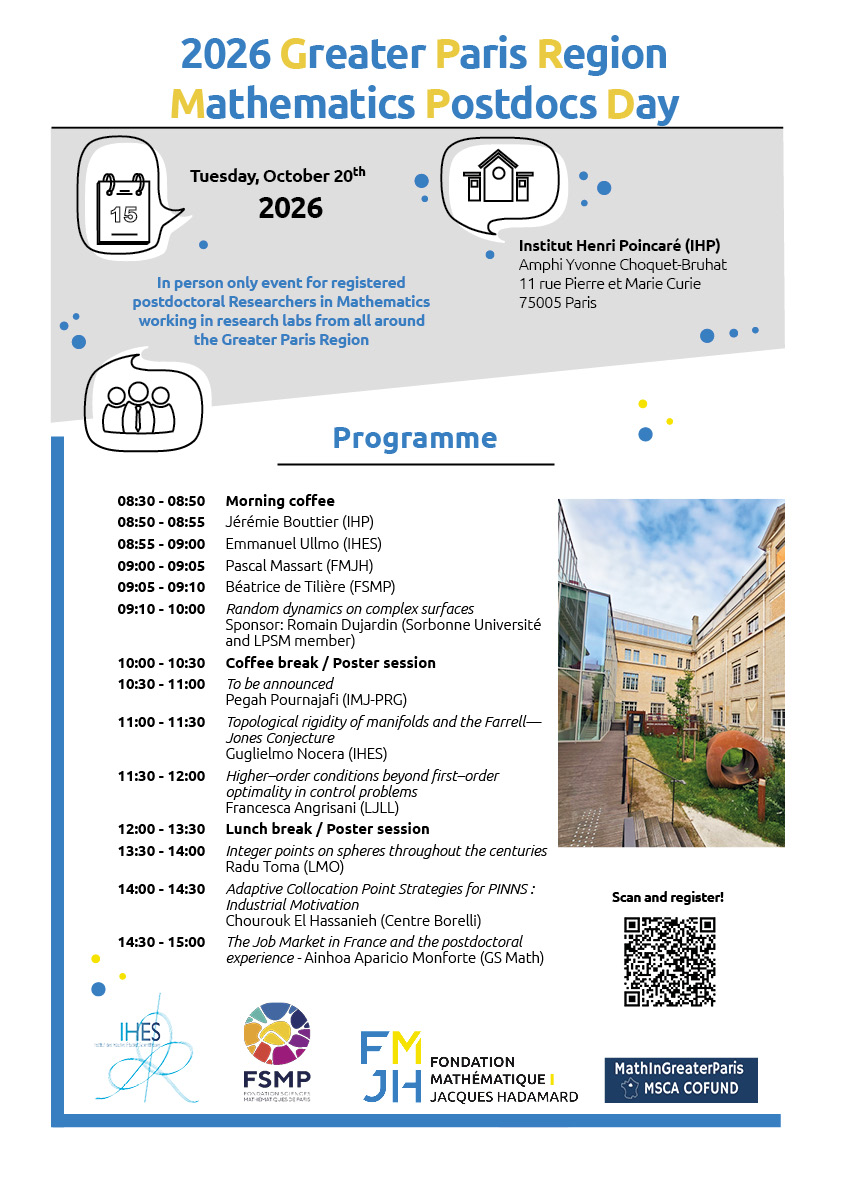
Cette année, la journée francilienne d'accueil des postdoctorant.e.s en mathématiques se déroulera le 20 octobre 2026 à l'IHP.
Journée francilienne d'accueil des postdoctorant.e.s en mathématiques 20 octobre 2026 à l'IHP
Au programme :
- Un exposé scientifique du parrain de cette édition, Romain Dujardin, Professeur à Sorbonne Université et membre du LPSM,
- Des présentations scientifiques par des postdoctorant·e·s expérimenté·e·s de la région parisienne,
- Des ateliers exposés informatifs et échanges sur les enjeux de carrière et les démarches administratives en France,
- Une session de posters - vous pouvez proposer un poster déjà présenté en conférence,
- Moments d’échange pour élargir votre réseau professionnel,
- Offert : Café d’accueil, pause-café et déjeuner.
Détails des exposés :
Exposé du parrain : Romain Dujardin (Professeur à Sorbonne Université et membre de LPSM) "Dynamique aléatoire sur les surfaces complexes"
Résumé : Mon objectif est de donner un aperçu de travaux que nous avons mené il y a quelques années avec Serge Cantat sur la dynamique aléatoire sur les surfaces algébriques complexes, et qui ont été complétés par d’autres auteurs depuis. J'expliquerai notamment comment certaines de ces constructions peuvent s’obtenir à partir de considérations élémentaires sur les pliages de polygones dans le plan.
Exposé n°1 : Pegah Pournajafi (IMJ-PRG) "to be announced"
Exposé n°2 : Guglielmo Nocera (IHES) "Topological rigidity of manifolds and the Farrell—Jones Conjecture"
Résumé : Let G be a torsionfree group. It is an open problem (the Borel Conjecture) whether every closed manifold M with the homotopy type of BG is topologically rigid: that is, given another closed manifold N homotopy equivalent to it, then M and N are homeomorphic. Farrell and Jones introduced an algebraic criterion, involving K- and L-theory, which implies the Borel Conjecture when the dimension of M is greater or equal than 5. I will present a brief explanation of this criterion and of related results of mine involving the so-called hermitian K-theory.
Exposé n°3 : Francesca Angrisani (LJLL) "Higher–order conditions beyond first–order optimality in control problems"
Résumé : "Higher–order conditions of Goh and Legendre–Clebsch type provide variational information beyond first–order analysis, allowing one to show that certain extremals satisfying the Pontryagin Maximum Principle cannot be local minimizers.
In the first part of the talk, I will present recent joint work with F. Rampazzo, where higher–order necessary conditions are derived for control–affine systems with merely Lipschitz continuous dynamics. By combining set–valued Lie brackets with the theory of Quasi Differential Quotients, we recover meaningful second and third order variational information in a fully nonsmooth setting, extending the classical smooth framework.
In the second part, I will outline how this nonsmooth analysis fits into a broader variational program aimed at understanding how higher–order necessary conditions persist under different sources of degeneracy, including state constraints, geometric degeneracies, and nonlocal interactions through measure–dependent dynamics. This perspective is particularly relevant for control and planning problems where first–order optimality conditions alone fail to capture the true variational structure.
Exposé n°4 : Radu Toma (LMO) "Integer points on spheres throughout the centuries"
Résumé : Consider spheres in R^3 centred at the origin. For some radii, they contain points with integer coordinates. Simple questions, such as which radii exactly satisfy this and then how many integral points are there on such spheres, have generated beautiful mathematics since the 17th century and continue today. I will give a short and accessible overview of this story.
Exposé n°5 : Chourouk El Hassanieh (Centre Borelli) "Adaptive Collocation Point Strategies for PINNS : Industrial Motivation"
Résumé : Since their re-introduction in 2019, physics informed neural networks have evolved much beyond the vanilla PINN. From novel optimizers into adaptively sampling collocation points or loss re-weighting strategies, PINNs are showing promising results whether it is accuracy of the predicted solutions or accelerated computation time. In this presentation I will introduce the problematic from an industrial viewpoint as well as an improved resampling strategy for choosing the collocation points tailored for improved Natural Gradient Descent optimization.
 Des photos et captations vidéos seront prises au cours de cette journée et pourront être utilisées dans le cadre de la politique de communication de la FMJH (diffusion site internet, supports de communication, réseaux sociaux etc).
Si vous ne souhaitez pas être photographié ou filmé, merci de vous signaler auprès d'Ainhoa Aparicio Monforte le jour de l'événement.
Les participant.e.s sont autorisés à prendre des photos pour un usage strictement personnel. Toute diffusion publique doit respecter le droit à l'image des personnes photographiées.
Pour toutes remarques ou complément d'informations, vous pouvez nous contacter : communication@fondation-hadamard.fr.