Greater Paris Postdocs in Mathematics Welcome Day
The Greater Paris Postdocs in Mathematics Welcome Day is an annual event co-organized by FMJH, FSMP, and IHES. As the name suggests, this event is open to all local postdocs in Mathematics.
The goal of the Welcome Day is to:
- Provide young mathematicians with an opportunity to meet their colleagues;
- Help newcomers find out more about the mathematical environment in the Paris region, including possible funding opportunities for future research projects;
- Give an overview of the French (academic) job market.
This year, the event will took place on October 20, 2026 at IHP.
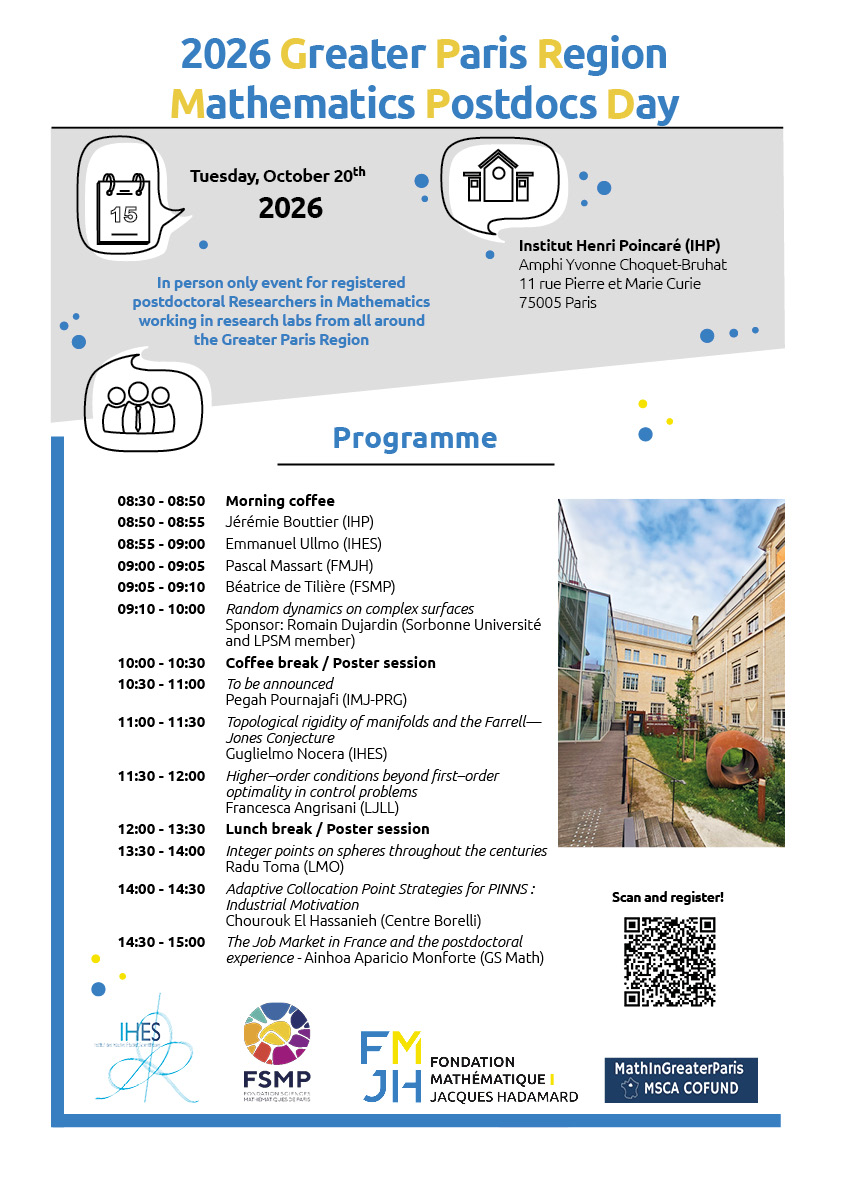
Greater Paris Region Mathematics Postdocs Day
October 20, 2026 at IHP
Highlights:
- A scientific talk by this year's sponsor, Mr. Romain Dujardin, Professor at Sorbonne Université and member of LPSM
- Scientific presentations by experienced postdoctoral researchers from the Greater Paris Region
- Informative talks and discussions on career development and navigating French bureaucracy
- Poster session – you are welcome to present a poster you’ve previously shared at a conference
- Networking opportunities with peers and leading institutions
- <meta charset="UTF-8">Complimentary: Welcome coffee, coffee break, and lunch
Presentations details:
Sponsor presentation: Romain Dujardin (Professor at Sorbonne Université and member of LPSM) "Dynamique aléatoire sur les surfaces complexes"
Résumé : Mon objectif est de donner un aperçu de travaux que nous avons mené il y a quelques années avec Serge Cantat sur la dynamique aléatoire sur les surfaces algébriques complexes, et qui ont été complétés par d’autres auteurs depuis. J'expliquerai notamment comment certaines de ces constructions peuvent s’obtenir à partir de considérations élémentaires sur les pliages de polygones dans le plan.
Presentation n°1 : Pegah Pournajafi (IMJ-PRG) "to be announced"
Presentation n°2 : Guglielmo Nocera (IHES) "Topological rigidity of manifolds and the Farrell—Jones Conjecture"
Résumé : Let G be a torsionfree group. It is an open problem (the Borel Conjecture) whether every closed manifold M with the homotopy type of BG is topologically rigid: that is, given another closed manifold N homotopy equivalent to it, then M and N are homeomorphic. Farrell and Jones introduced an algebraic criterion, involving K- and L-theory, which implies the Borel Conjecture when the dimension of M is greater or equal than 5. I will present a brief explanation of this criterion and of related results of mine involving the so-called hermitian K-theory.
Presentation n°3 : Francesca Angrisani (LJLL) "Higher–order conditions beyond first–order optimality in control problems"
Résumé : "Higher–order conditions of Goh and Legendre–Clebsch type provide variational information beyond first–order analysis, allowing one to show that certain extremals satisfying the Pontryagin Maximum Principle cannot be local minimizers.
In the first part of the talk, I will present recent joint work with F. Rampazzo, where higher–order necessary conditions are derived for control–affine systems with merely Lipschitz continuous dynamics. By combining set–valued Lie brackets with the theory of Quasi Differential Quotients, we recover meaningful second and third order variational information in a fully nonsmooth setting, extending the classical smooth framework.
In the second part, I will outline how this nonsmooth analysis fits into a broader variational program aimed at understanding how higher–order necessary conditions persist under different sources of degeneracy, including state constraints, geometric degeneracies, and nonlocal interactions through measure–dependent dynamics. This perspective is particularly relevant for control and planning problems where first–order optimality conditions alone fail to capture the true variational structure.
Presentation n°4 : Radu Toma (LMO) "Integer points on spheres throughout the centuries"
Résumé : Consider spheres in R^3 centred at the origin. For some radii, they contain points with integer coordinates. Simple questions, such as which radii exactly satisfy this and then how many integral points are there on such spheres, have generated beautiful mathematics since the 17th century and continue today. I will give a short and accessible overview of this story.
Presentation n°5 : Chourouk El Hassanieh (Centre Borelli) "Adaptive Collocation Point Strategies for PINNS : Industrial Motivation"
Résumé : Since their re-introduction in 2019, physics informed neural networks have evolved much beyond the vanilla PINN. From novel optimizers into adaptively sampling collocation points or loss re-weighting strategies, PINNs are showing promising results whether it is accuracy of the predicted solutions or accelerated computation time. In this presentation I will introduce the problematic from an industrial viewpoint as well as an improved resampling strategy for choosing the collocation points tailored for improved Natural Gradient Descent optimization.
 Photos and videos will be taken during the day and may be used as part of the FMJH's communication policy (website distribution, communication media, social networks, etc.).
If you do not wish to be photographed or filmed, please notify Mrs Ainhoa Aparicio Monforte the day of the event.
Participants are allowed to take photos for strictly personal use. Any public dissemination must respect the image rights of the persons photographed.
For any comments or further information, please contact us at: communication@fondation-hadamard.fr.